In short
Many business owners start their research with the word thuisbatterij, or home battery. It is a fair starting point: the idea is the same. You store electricity when you have too much or when it is cheap, and use it later. But a company battery works at a different scale, does more jobs and comes with more rules. This guide explains the differences and helps you decide whether a home-style battery is enough for your business.
What is the basic difference?
A home battery sits behind a household meter. Its main job is self-consumption: using more of your own solar power in the evening instead of injecting it at a low price.
A business battery (BESS, battery energy storage system) sits on a company site. It does that job too, but it also lowers peaks, frees up room on your grid connection for EV chargers and can earn money on energy markets. An energy management system (EMS) decides every quarter-hour which job pays most.
How do they compare?
Battery size is described by two numbers: power in kW (how fast it charges or discharges) and capacity in kWh (how much it stores). Our glossary explains kW versus kWh.
| Home battery | Business battery | |
|---|---|---|
| Typical capacity | A few kWh to about 20 kWh | Tens of kWh to several MWh |
| Typical power | A few kW, single- or three-phase | Tens of kW to MW, three-phase, sometimes on medium voltage |
| Main purpose | Store own solar for the evening | Peak shaving, more EV chargers, self-consumption, market revenue |
| Control | Built-in app or simple settings | EMS that combines site, solar, chargers and market prices |
| Revenue streams | Savings on own bill | Savings plus energy arbitrage and balancing markets via an aggregator |
| Registration (Flanders) | Online notification to Fluvius up to 25 kVA | Grid study above 25 kVA; telecontrol from 250 kVA of storage |
| Environmental rules | Usually none in Flanders; check thresholds in Brussels and Wallonia | Brussels and Wallonia classify stationary batteries above about 10 kWh |
| Installation | Installer, AREI inspection | Project with engineering, grid study, fire safety and AREI inspection |
What can a business battery do that a home battery cannot?
- Cut your peaks. Companies on low voltage in Flanders pay a capacity tariff, the part of the grid bill based on your highest 15-minute peak of the month. Larger sites on medium voltage pay for peaks too. Peak shaving means the battery covers those short peaks.
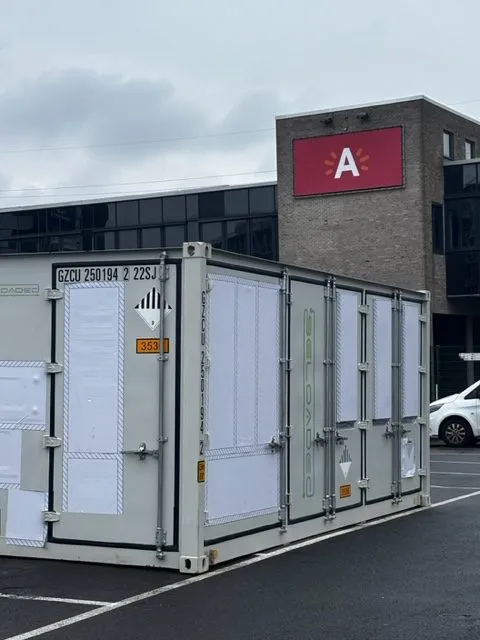
- Add EV chargers without a grid upgrade. At a logistics site in the port of Antwerp, a 500 kW / 1 MWh battery raised the available capacity from 90 kW to almost 600 kW, so the company could move towards electric trucks. Read more in our guide on adding EV chargers without a grid upgrade.
- Trade on prices. With a dynamic contract, the battery charges when day-ahead prices are low or negative and discharges when they are high.
- Earn on balancing markets. Elia buys reserves such as FCR and aFRR to keep the grid stable. The minimum bid is 1 MW, so company batteries usually join through an aggregator. In Harelbeke, a 500 kW / 1,290 kWh battery takes part in FCR and aFRR.
A home battery can help a little with points 1 and 3 at household scale, but not with points 2 and 4.
How big are business batteries in practice?
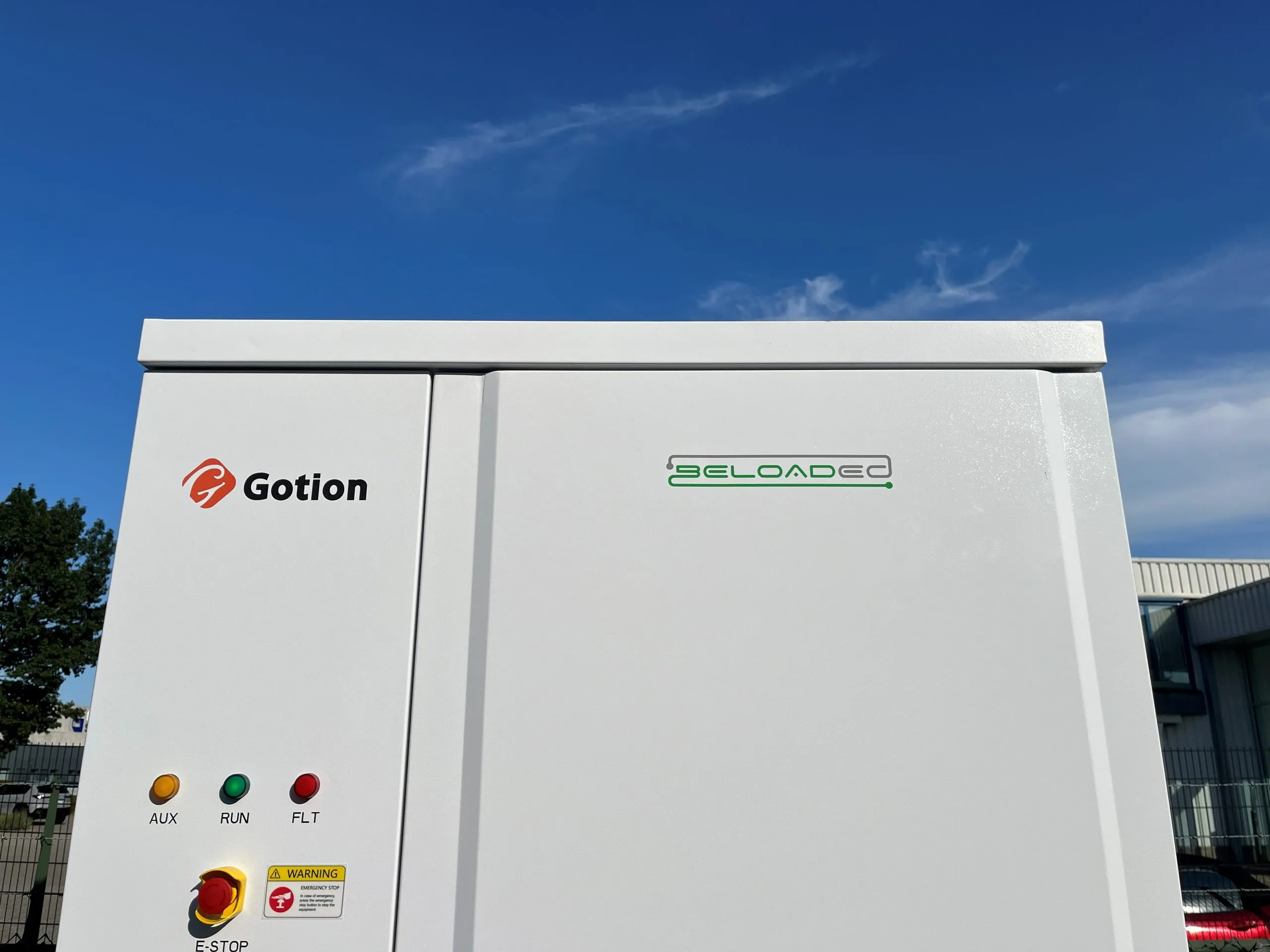
BeLoaded’s battery range shows the scale: Mono Block units of 125 and 260 kWh for SMEs and shops, modular systems from 200 to 2,000 kWh for industry, and container solutions of 1, 2 and 5 MWh for large sites and charging parks.
Real projects are similar. In Puurs, a 62.5 kW / 215 kWh battery balances AC and DC chargers with a combined 120 kW. In Herentals, a 100 kW / 211 kWh pilot battery stores solar surplus. Even the smallest of these is roughly ten times a typical home battery.
When is a home-style battery enough for a small business?
A home-style battery can be the right choice when most of these are true:
- You have a normal low-voltage connection, like a shop, office, practice or small workshop.
- Your solar installation is modest and you inject a clear surplus at midday.
- You have no or few EV chargers and no big machines that cause high peaks.
- Your main goal is self-consumption and a slightly lower monthly peak.
- You do not plan to earn money on balancing markets.
Before you buy, check three things. Is the inverter on Synergrid’s approved list for the Belgian grid? Does the warranty cover business use? And in Brussels or Wallonia, does the battery stay below the 10 kWh threshold for environmental classification, or do you need to file a declaration or permit?
The Flemish home battery premium no longer helps here. It stopped for batteries inspected after 31 March 2023 and was only for natural persons.
When do you need a real business battery?
Look at a business battery when your peaks come close to your grid connection, when you plan more EV chargers, when you have a large solar installation, when you are on medium voltage, or when you want market revenue. These cases need proper sizing on your 15-minute data, an EMS and a project approach with grid study, fire safety and permits. Our guide on battery permits and fire safety lists those steps.
Not every company needs a battery at all. Sometimes smart EV charging, shifting consumption or a better contract does more for less. Our guide on whether a business battery is worth it helps you decide.
Example: a bakery and a distribution centre
The numbers are round and hypothetical.
A bakery has 20 kWp of solar panels. On a sunny afternoon it injects about 15 kWh it does not use. A 10 kWh home-style battery stores most of that surplus for the evening. That is a simple, sensible set-up. A business battery would sit idle most of the day.
A distribution centre has 400 kWp of solar, 20 charge points and a grid connection of 250 kVA. Its peaks in the morning reach 400 kW when vans and forklifts charge at once. A 10 kWh home-style battery delivers only a few kW, a small fraction of such a peak. A 250 kW / 500 kWh business battery with an EMS can cover the peaks, store the solar surplus and charge cheaply when prices drop. It also triggers telecontrol in Flanders and a grid study, which belong in the plan from the start.
Checklist
- Download 12 months of 15-minute data from your grid operator.
- Note your highest monthly peaks and your grid connection limit.
- Estimate your solar surplus on sunny days.
- List planned EV chargers and new electric machines.
- Decide which jobs the battery must do: self-consumption only, or also peaks and markets.
- Check the rules for your region before choosing a size.
Next step
The fastest way to know which battery fits is to look at your own data. Do the quick check for a first answer. If a business battery makes sense, our battery page explains the systems and the energy management system that steers them. Projects such as Zandhoven and Antwerp show the results on real sites.
Sources
- Fluvius – Notification obligation for storage systems
- Fluvius – How the capacity tariff is charged
- Vlaanderen.be – Home battery premium stopped
- Bruxelles Environnement – Stationary batteries and UPS units (rubric 3)
- Elia – Bidding rules for balancing services (FCR, aFRR)
Updated: 29 October 2026