In short
A battery for your company is an electrical installation, a piece of equipment connected to the public grid and a fire risk that must be controlled. That means several authorities have a say: the electrical inspection body, your grid operator, the region, the municipality, the fire service and your insurer. The rules also differ between Flanders, Brussels and Wallonia. This guide lists what is typically needed in 2026 and in which order, so nothing blocks your project at the last moment.
Rules change often. Use this guide to prepare, and always confirm the details for your site with the authority concerned.
Which permits and approvals does a company battery need?
The table below gives the overview per region. A battery (BESS, battery energy storage system) is described by its power in kW or kVA and its capacity in kWh. Our glossary explains kW versus kWh.
| Topic | Flanders | Brussels | Wallonia |
|---|---|---|---|
| Environmental classification | Not in the VLAREM classification list; general conditions of VLAREM II part 6 apply | Rubric 3: stationary batteries above 10,000 VAh (about 10 kWh) need an environmental permit | Rubric 40.10.01.02: stationary batteries above 10,000 Ah × V (about 10 kWh) are a classified activity |
| Building or planning permit | Possible, depending on size and location (for example a container outside) | Check with the municipality and urban planning | Check with the municipality |
| Electrical inspection | AREI inspection by a recognised body before use | Same (AREI is federal) | Same (AREI is federal) |
| Grid operator | Notify Fluvius; grid study above 25 kVA; telecontrol from 250 kVA of storage | Sibelga procedure | ORES or RESA procedure |
| Fire service | Advice as part of a permit procedure | Operating conditions include fire safety for battery rooms | Inform the fire service before commissioning |
What do the environmental rules say?
Flanders. The Flemish environment department states that battery systems do not produce electricity and are therefore not listed in the VLAREM classification list. The environmental conditions for non-classified activities in part 6 of VLAREM II apply, with chapter 6.13 named as relevant for battery parks. Other parts of your site, such as a transformer, may be classified on their own. Depending on the size and location, you may need an omgevingsvergunning for the building work, for example to place a container. The fire service gives advice in that procedure.
Brussels. Stationary batteries and UPS units above 10,000 VAh fall under rubric 3 of the Brussels environmental permit list. Bruxelles Environnement publishes the operating conditions, set by a government order of 17 December 2020. For battery rooms they include fire-resistant walls and doors, ventilation for open batteries and fire extinguishers outside the room.
Wallonia. A Walloon government order of 23 November 2006 sets conditions for stationary batteries where capacity in Ah multiplied by voltage in V exceeds 10,000, under rubric 40.10.01.02. It requires, among other things, a way to collect leaking electrolyte and that the operator informs the fire service before commissioning. Ask your municipality which procedure applies to your project.
What does the electrical inspection cover?
Belgium’s electrical safety rules are the AREI (in French: RGIE). A new installation and every significant extension must be inspected by a body recognised by FOD Economie before it is used. Book 1 covers low-voltage installations. Book 2 covers high voltage, which matters if your site has its own medium-voltage cabin. The inspection report is also one of the documents your grid operator will ask for.
What does the grid operator require?
A battery can push power back into the grid, so the grid operator must know about it and approve it.
- Notification. In Flanders, every storage system must be reported to Fluvius. Small systems up to 25 kVA go through the online portal. Larger systems go through a grid study, which checks your grid connection capacity and local grid congestion.
- Technical rules. The Synergrid rule C10/11 treats a battery that can run in parallel with the grid as a production installation. The battery inverter must be on the approved C10/26 list. Up to 30 kVA in total, an inverter’s built-in disconnection system can be enough. Above that, an external grid decoupling relay is needed. Battery and solar inverters count together.
- Telecontrol (Flanders). Under the Flemish technical regulation (TRDE) as amended in 2026, Fluvius imposes telecontrol when the energy storage on one connection adds up to 250 kVA or more. It also applies to connections of 1,000 kVA or more, and to connections from 400 kVA when a grid study shows congestion. Telecontrol lets the grid operator limit your grid injection or offtake when the grid needs it. Batteries used only as emergency backup are exempt.
In Brussels and Wallonia, Sibelga, ORES and RESA have their own procedures and technical requirements. Ask early, because grid studies take time.
How do you handle fire safety?
Most company batteries use lithium cells. They are safe when well designed and managed, but a fire is hard to put out. That is why fire services and insurers want to see the risk controlled before the battery is built. They typically look at:
- the battery chemistry, certificates and test reports;
- the location, and the distance to buildings, escape routes and neighbours;
- access for fire trucks and an emergency shutdown;
- detection, ventilation and any built-in extinguishing system;
- monitoring by the battery management system and an energy management system that raises alarms.
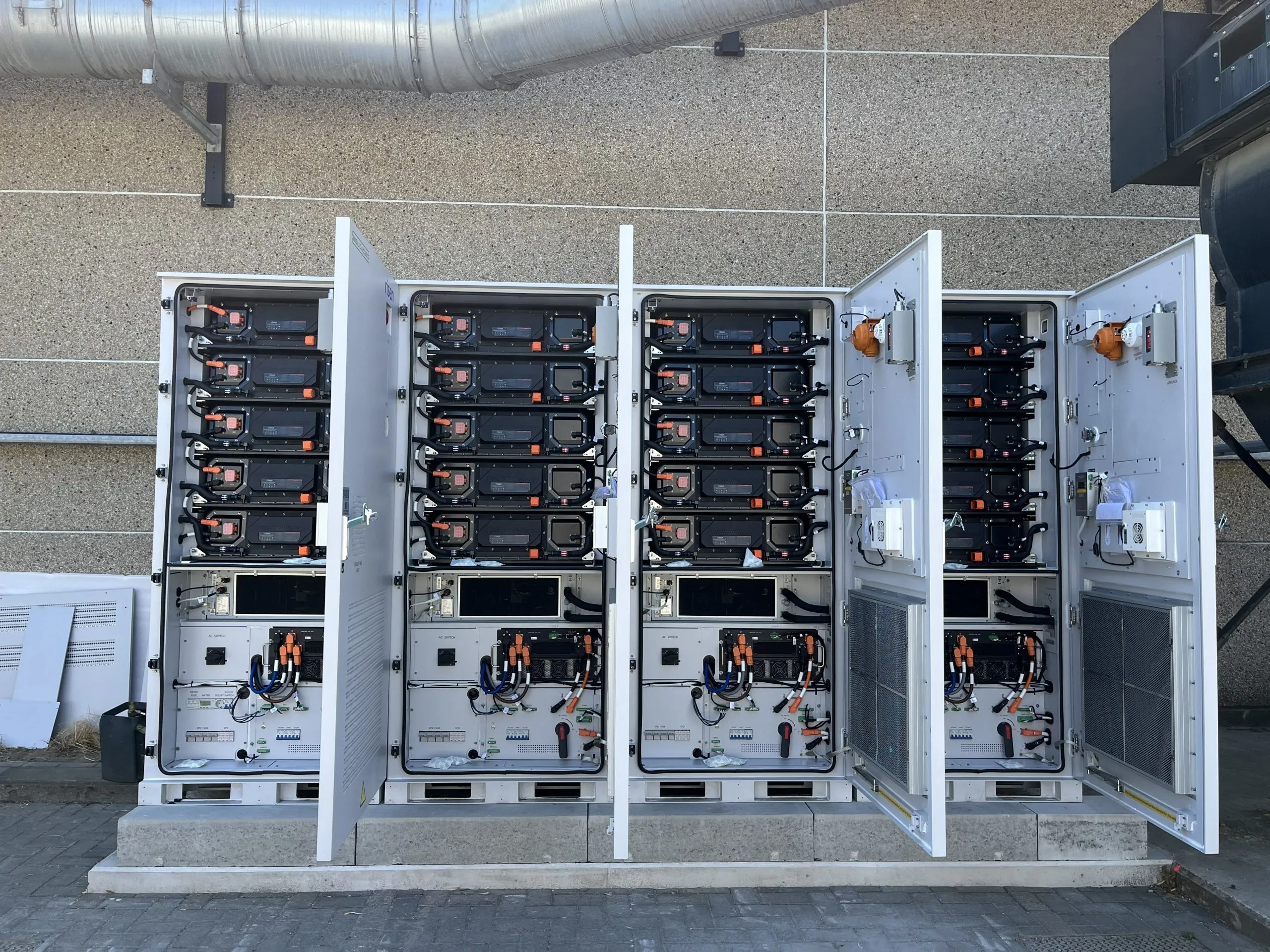
The Belgian fire safety association ANPI published a technical dossier on lithium energy storage systems in 2023, written for decision makers, facility managers, emergency services and insurers. As one example of design choices, BeLoaded’s ZBlock 260-L uses liquid cooling, a multi-level battery management system with cell monitoring, IP54 protection and an optional integrated fire suppression system.
Tell your insurer about the project before you sign the order. Some insurers set conditions on location or protection.
Example: the same battery in three regions
The project below is hypothetical.
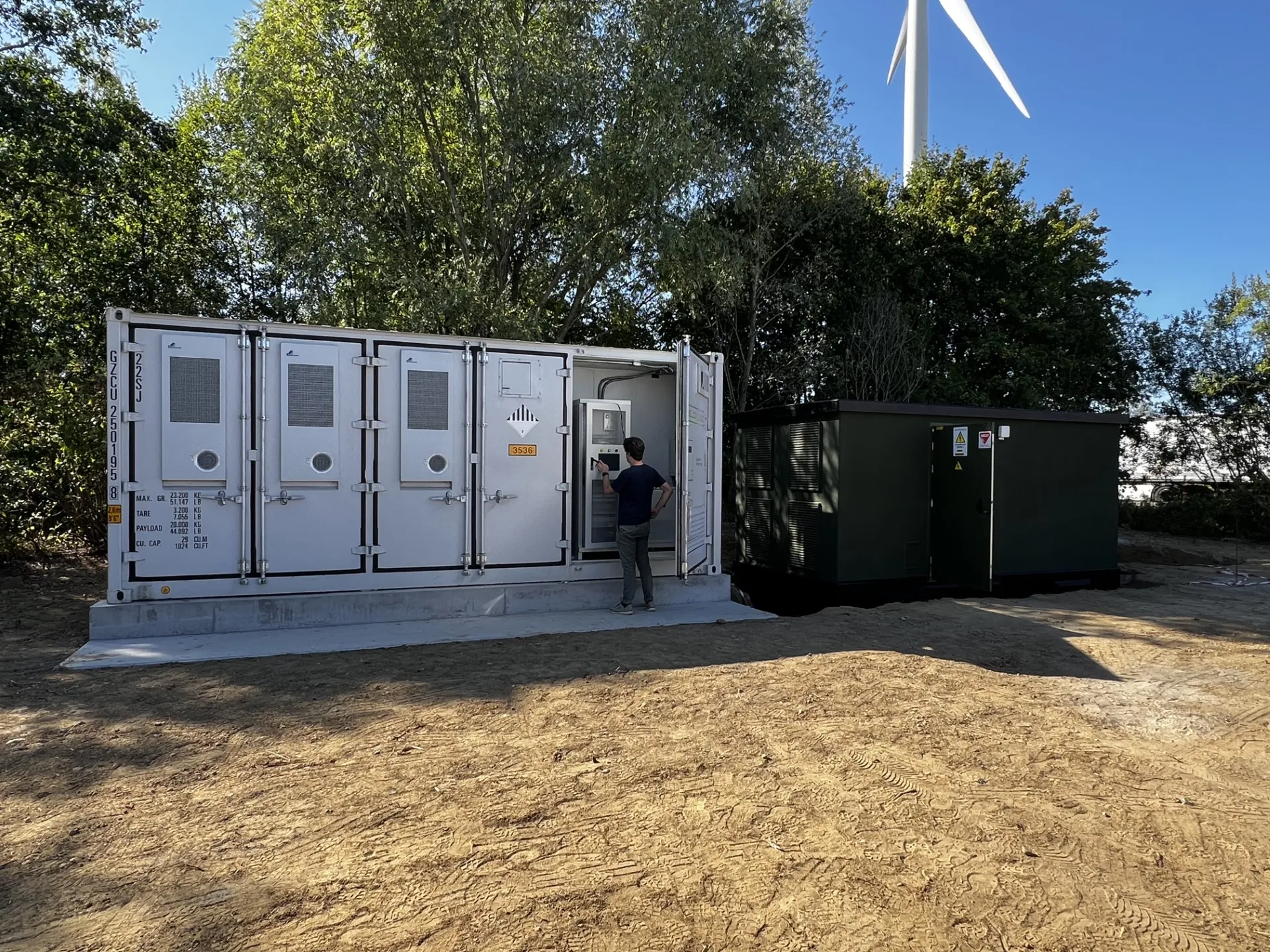
A company plans a 500 kW / 1 MWh battery in an outdoor container, on a site with a 600 kVA grid connection.
- In Flanders: no VLAREM classification for the battery, but the container may need a permit for the building work, with fire service advice. AREI inspection before use. Fluvius grid study. Because the storage is 500 kVA, telecontrol is mandatory. An external decoupling relay is needed.
- In Brussels: the same battery is far above 10 kWh, so it needs an environmental permit under rubric 3, plus the AREI inspection and Sibelga’s procedure.
- In Wallonia: it is a classified activity under rubric 40.10.01.02. The operator must inform the fire service before commissioning, plus AREI inspection and the ORES or RESA procedure.
In all three regions, the insurer should see the plan before the order is placed.
What if a battery is already installed without all approvals?
It happens, especially with older or fast-built projects. The way forward is regularisation. In Turnhout, BeLoaded took over an existing installation and arranged its regularisation with the fire service and the grid operator’s telecontrol, while refocusing the control strategy.
What happens at the end of the battery’s life?
Batteries fall under Belgian and European rules for collection and recycling, including the EU Battery Regulation. As a supplier, BeLoaded manages the end-of-life process for its battery systems, aiming to recover as much material as possible.
Checklist
- Confirm your region and ask the municipality which environmental and building procedure applies.
- Check your grid connection and start the grid operator’s procedure early.
- Make sure the inverter is on the C10/26 list and plan the decoupling protection.
- Check whether telecontrol applies and include the hardware in the budget.
- Involve the fire service and your insurer before you fix the location.
- Book the AREI inspection before commissioning.
- Keep certificates, single-line diagrams and reports in one file.
Next step
Permits and grid rules are a common reason battery projects slip by months. Start with the quick check to see whether a battery fits your site. BeLoaded’s PMO and compliance support then coordinates the grid studies, authorities and paperwork, and our commissioning services make sure the installation is inspected and connected correctly.
Sources
- Departement Omgeving (Flanders) – Wetwijzer: batteries and VLAREM
- Bruxelles Environnement – Stationary batteries and UPS units (rubric 3)
- Wallex – Walloon government order of 23 November 2006 on stationary batteries
- Vlaanderen.be – Inspection of your electrical installation (AREI)
- Fluvius – Notification obligation for storage systems
- Vlaamse Nutsregulator – TRDE consolidated version 2026 (telecontrol, art. 2.2.54)
Updated: 29 October 2026