In short
The capacity tariff is the part of your grid costs that depends on your highest power peak, not on the total energy you use. In Flanders it applies to every company since 1 January 2023. If your site switches many machines, heat pumps or EV chargers on at the same moment, you pay for that moment all year long. The good news: a peak is often easy to move.
What is the capacity tariff?
Your electricity bill has three parts: the energy itself, taxes and levies, and grid costs. The capacity tariff sits in the grid costs. It pays for the network that the grid operator (Fluvius in Flanders) has to build to carry your highest load.
The logic is simple. Cables and transformers must be sized for the busiest moment, not for the average. So the tariff charges you on that busiest moment. This is why it helps to understand kW versus kWh: kW is how hard you pull on the grid right now, kWh is how much energy you use over time.
How is my peak measured?
Your digital meter records your average power for every quarter of an hour. That gives 96 values per day.
- The highest quarter-hour in a month is your monthly peak, in kW.
- On a low-voltage connection in Flanders, Fluvius bills the average of your last 12 monthly peaks.
- Each month counts for at least 2.5 kW, even if your real peak was lower.
In 2026 the Flemish rate for low-voltage connections is roughly €52 to €61 per kW per year including VAT, depending on your Fluvius area. A peak of 100 kW therefore costs several thousand euros per year before you use a single kWh.
Does the capacity tariff work the same for every company?
No. It depends on your region and on how you are connected.
| Your situation (2026) | How peaks are charged |
|---|---|
| Flanders, low voltage | Average of the last 12 monthly peaks, minimum 2.5 kW per month |
| Flanders, medium voltage (large consumer metering) | Monthly peak plus an access power you choose in Mijn Fluvius; going above it costs 50% more, for that month and the next 11 |
| Wallonia, low voltage up to 56 kVA | Capacity term set at €0 per kW for 2026–2029; time-of-use tariffs instead |
| Wallonia, connections with peak metering | Monthly and annual peak charges (for example in the ORES 2026 tariffs) |
| Brussels, low voltage | No measured-peak tariff yet; a capacity part based on the power made available to you starts on 1 January 2028 |
For medium-voltage companies in Flanders, the access power works like a phone plan. You reserve a peak in advance. Stay under it and you pay the reserved amount. Go over it and you pay a higher rate for a full year. You can raise your access power every month, but you can only lower it 12 months after the last increase.
How do I read my own peak?
You do not need special tools to start.
- Log in to Mijn Fluvius (Flanders) or ask your supplier for your monthly peaks over the last 12 months.
- Download your quarter-hour data if you can. Most companies with a digital or AMR meter have access to it.
- For each month, note the date and time of the peak.
- Ask the people on site what was running at that moment. Often it is the same story every month.
This simple exercise shows whether your peak is a one-off or a pattern. A pattern can usually be fixed.
What drives a high peak?
Peaks are rarely caused by one big machine. They come from several loads that overlap in the same 15 minutes. Common causes we see on Belgian sites:
- EV chargers that all start when staff arrive between 8:00 and 9:00
- Heating, cooling or heat pumps restarting after a weekend or a night setback
- Production lines, compressors or ovens switched on together at the start of a shift
- A kitchen, a car wash or a cold store that runs at full power at a fixed hour
How can I lower my capacity tariff?
There are four main options. Most sites combine two or more.
- Spread your loads. Start machines in sequence, shift a cleaning cycle, or pre-cool a cold store earlier. This often costs nothing.
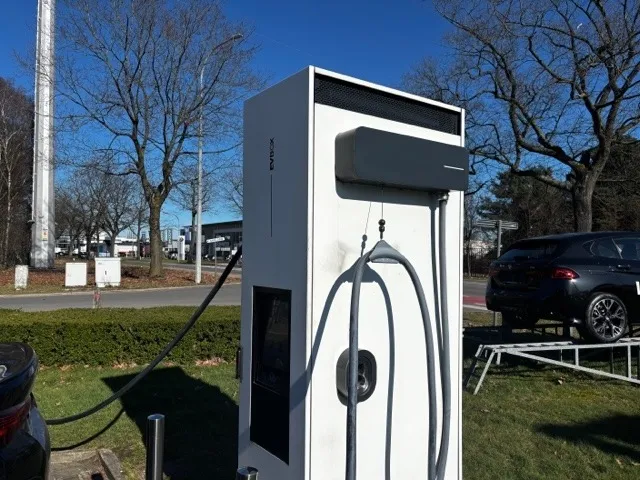
- Charge EVs smartly. Load balancing shares the available power across your charge points, so the cars still charge but never all at full power together. See our load balancing solution.
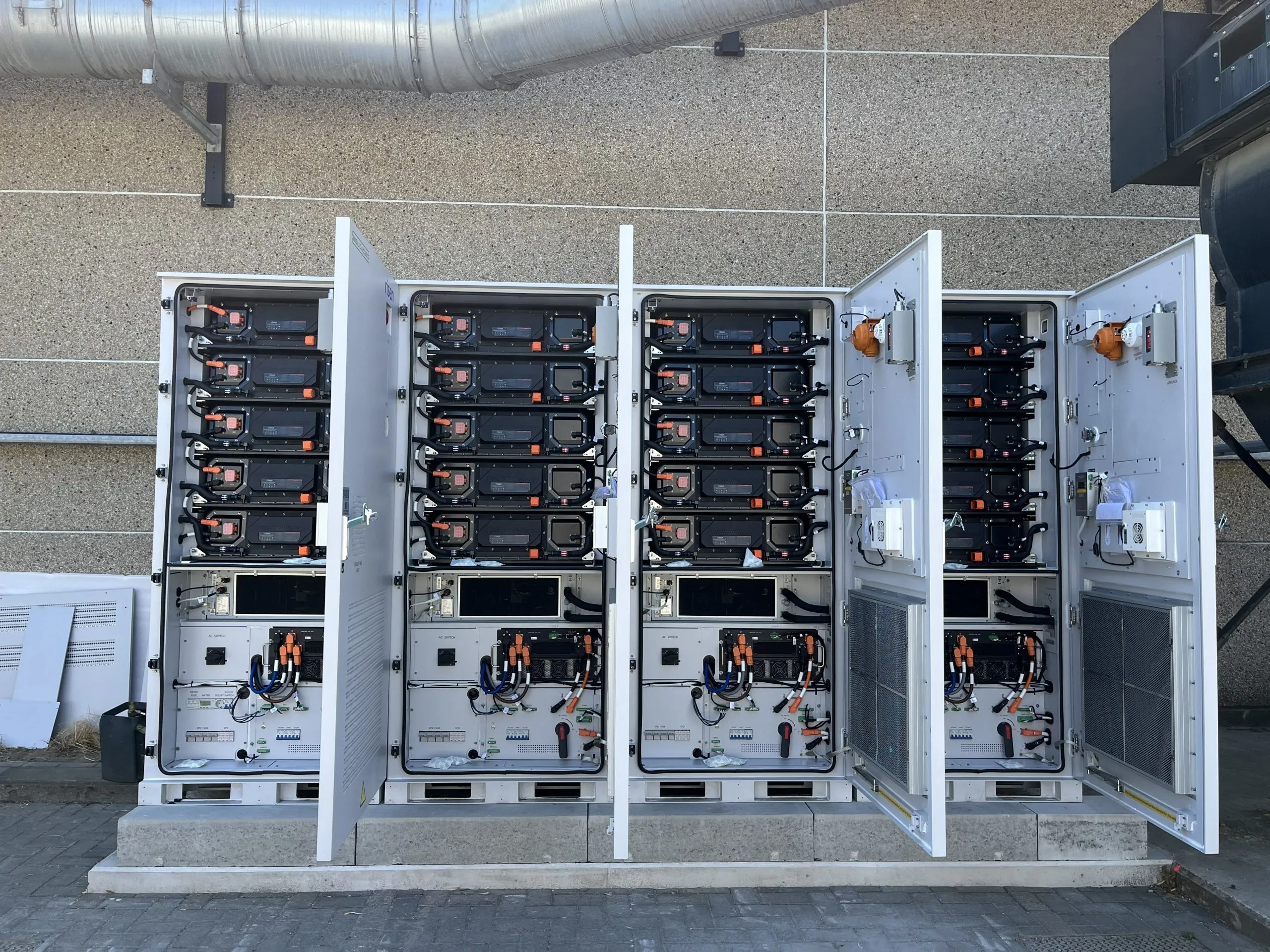
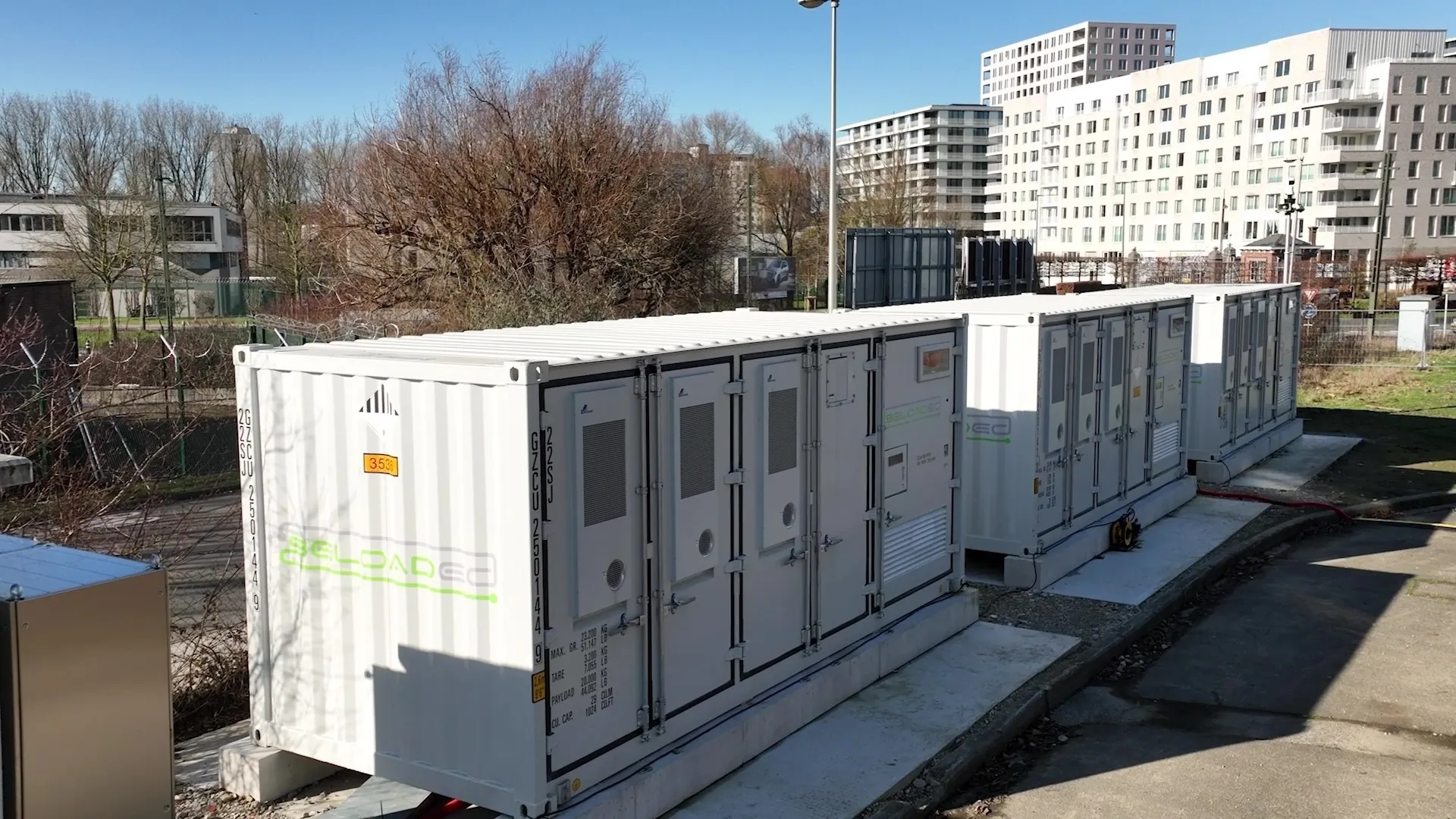
- Use a battery for peak shaving. A company battery (BESS) discharges during your peak, so the grid sees less. This is called peak shaving. It pays best when the same battery also stores solar power or trades on energy markets.
- Let an EMS steer everything. An energy management system watches your site in real time and keeps the total under a limit you choose. It decides which load waits, when the battery helps and when chargers slow down.
Two BeLoaded projects show how this works in practice. In Turnhout, BeLoaded moved the EMS to self-consumption and DC load balancing to minimise peaks and lower contracted volumes. In Anderlecht, the EMS is configured to reduce the capacity tariff once solar panels and over 60 charge points are added.
Example: what is one peak worth?
Example (hypothetical round numbers): a logistics company in Flanders on low voltage. Its monthly peak is 200 kW, every month, at 8:30. At that moment, 10 EV chargers of 11 kW start together while the heating restarts.
- Assume a capacity rate of €50 per kW per year.
- Capacity tariff today: 200 kW × €50 = €10,000 per year.
- With smart charging, the chargers share 40 kW instead of 110 kW at 8:30. The heating start is moved 30 minutes earlier. The new peak is 130 kW.
- New capacity tariff: 130 kW × €50 = €6,500 per year.
That is a saving of €3,500 per year, mostly from software settings. Because Flanders uses a 12-month average, the saving builds up month by month and reaches its full level after about a year. Your real rate depends on your grid area, voltage level and VAT status.
Checklist: is this for you?
- Your monthly peak shows up at the same time of day, month after month
- You have, or plan, more than a handful of EV charge points
- You run heat pumps, compressors, ovens or cooling that start at fixed times
- You are on medium voltage and are unsure what access power to choose
- You have solar panels and want to use more of your own power
- You plan to grow (more vehicles, a new line) without a heavier grid connection
Next step
Want to know how big your peak really is and what drives it? Do the free quick check and get a first idea of your options in a few minutes. To see how one system can keep your site under a fixed limit, read more about our energy management system. If EV charging is the main cause, start with load balancing.
Sources
- Fluvius – Capaciteitstarief
- Fluvius – Handleiding toegangsvermogen bij grootverbruiksmeting (PDF)
- Callmepower – Capaciteitstarief 2026 per Fluvius-netgebied
- CWaPE – FAQ structure tarifaire basse tension 2026-2029 (PDF)
- BRUGEL – Décision 390 tarification évoluée Sibelga (PDF, July 2026)
- ORES – Tarifs de refacturation du transport 2026 (PDF)
Updated: 29 October 2026