In short
You can usually add many more EV chargers without a heavier grid connection. The trick is to stop treating every charger as if it needs full power at the same time. With load balancing, your chargers share the power that is left on your connection. A battery can add more on top. This guide explains how it works and when a grid upgrade is still the better choice.
Why do more chargers run into your grid connection?
Every site has a maximum power it may take from the grid, set in your connection contract. This is your grid connection capacity. Your building already uses part of it for lighting, heating, machines and IT.
Now add chargers. Twenty charge points of 22 kW add up to 440 kW if they all run flat out. On paper, that means a heavier connection: a new cabin, a transformer, months of waiting and a large bill. In areas with grid congestion, extra capacity may not even be available soon.
In reality, cars rarely all need full power at once. They arrive at different times, have different battery levels and stay parked for hours. That is the room that load balancing uses.
What is load balancing?
Load balancing means a controller divides the available power across your charge points. It decides, second by second, how much each charger may use. The total never goes above the limit you set. Cars still charge, but they share.
This protects your connection and also your capacity tariff, the grid cost based on your highest 15-minute peak. Without control, EV charging is one of the most common causes of a high peak.
Static or dynamic load balancing?
There are two main types.
| Static load balancing | Dynamic load balancing | |
|---|---|---|
| How it works | Chargers share a fixed maximum, for example 100 kW | Chargers get whatever is left after the building’s own use, measured live |
| What it needs | Settings in the chargers or a simple controller | A meter at the main connection and a controller or EMS |
| Strength | Simple and cheap | Uses all spare capacity; adapts to solar production |
| Weakness | You keep a margin all day, so capacity is wasted | Slightly more set-up work |
| Best for | Small sites with few chargers | Sites with many chargers, solar panels or variable loads |
Dynamic load balancing can also set priorities. Fleet vehicles that leave early can go first. Visitors can get a minimum. When your solar panels produce, the chargers can take more.
How does a battery add charging power?
Sometimes the spare capacity is simply too small. Then a company battery can act as a buffer. It charges slowly from the grid, or from your solar panels, when there is room. It discharges when cars need more power than the connection allows.
Two BeLoaded projects show the effect:
- In Puurs, the import limit is much lower than the 69 kW of the DC fast charger alone. A 62.5 kW / 215 kWh battery boosts the available power, so cars charge faster without exceeding the contract.
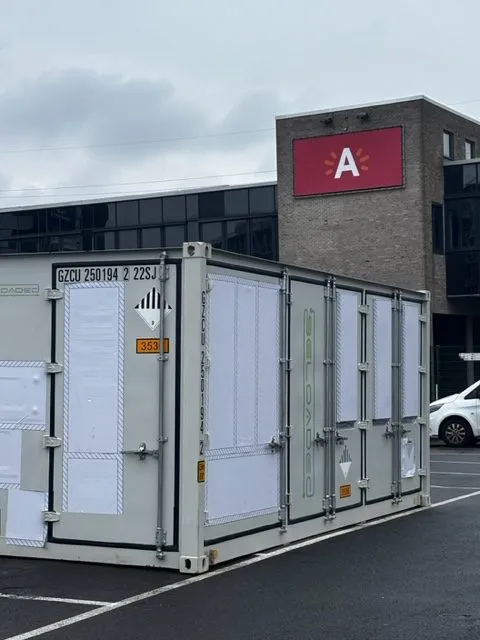
- At a logistics site in the port of Antwerp, the grid could not offer enough capacity to switch to electric trucks. A 500 kW / 1 MWh battery raised the available capacity from 90 kW to almost 600 kW.
Why does OCPP matter?
OCPP (Open Charge Point Protocol) is an open standard that lets charge points talk to a management system. OCPP 1.6 already supports smart charging with charge profiles. If your chargers speak OCPP, any compatible controller can steer them. You keep the freedom to add other brands later.
BeLoaded works with three ways of balancing:
- CANbus master/slave. Chargers with the EVC100 controller share the available grid and solar power between themselves, without extra hardware or software.
- OCPP proxy. An extra controller reads the available power and running sessions, then sets each charger’s limit over OCPP 1.6J.
- Central controller via Modbus TCP. All assets, including chargers, connect to one controller that recalculates loads every second. It can also follow EPEX market prices.
Example: 30 chargers on a 250 kW connection
Example (hypothetical round numbers): an office site with a 250 kW connection. The building itself peaks at 130 kW, but uses about 80 kW on an average working day. The company wants 30 chargers of 11 kW for staff.
- 30 chargers × 11 kW = 330 kW at full power. That is more than the whole connection.
- Each car needs about 20 kWh per day. 30 cars × 20 kWh = 600 kWh per day.
- Static balancing: you keep a margin for the building’s peak, so the chargers get a fixed 120 kW. Over 9 working hours that is 1,080 kWh. It fits, but with little room to grow.
- Dynamic balancing: on an average day the chargers get about 170 kW (250 minus 80). Over 9 hours that is about 1,500 kWh. You could charge more than twice the current fleet on the same connection.
No grid upgrade needed. The capacity tariff stays under control because the total never passes 250 kW.
Real project: 112 chargers in Brussels
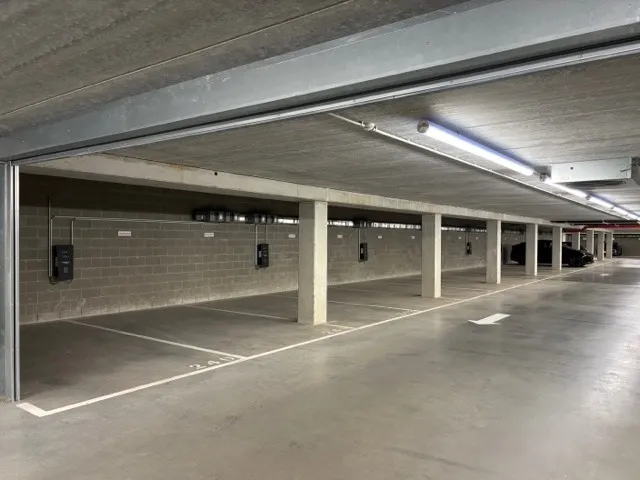
The Resolve underground car park in the north of Brussels has 112 charge points of 22 kW each. At full power, that would be close to 2.5 MW. A central EMS balances all of them dynamically, so the site stays within its contractual limits and infrastructure constraints.
When is a grid upgrade still the better choice?
Load balancing is not magic. A heavier connection may still make sense when:
- Your vehicles need large amounts of energy in a short time, every day (for example trucks with short stops)
- Your building already uses most of its capacity, all day
- You plan very large growth, such as a public fast-charging hub
Even then, load balancing and a battery can bridge the months you wait for the grid operator.
Checklist: is this for you?
- You want to add charge points but your connection seems “full”
- Your monthly peak rises since staff or fleet cars charge on site
- You have a car park with more than 20 spaces in Flanders and must meet the charge point rules
- You have solar panels and want cars to charge on your own power
- You want to stay free to choose charger brands later
- You are electrifying vans or trucks and the grid operator offers too little capacity
Next step
Find out how much charging capacity your connection already has. Do the free quick check for a first answer in a few minutes. Then read how our load balancing works, and where a battery can add the extra power you need.
Sources
- Open Charge Alliance – Open Charge Point Protocol (OCPP)
- Vlaanderen.be – Verplichtingen voor laadpunten bij parkings
- Fluvius – Capaciteitstarief
- Fluvius – Handleiding toegangsvermogen bij grootverbruiksmeting (PDF)
Updated: 29 October 2026